
Sally Russell is a Hampshire-based writer and musician with an MA in creative writing. She writes poetry that examines social relationships and family. Her work can be found in a number of journals and anthologies including Canberra University’s AXON, the Bangor Literary Journal and the Welsh Poetry Competition anthology. Sally has provided technical support for Loose Muse and facilitated a poetry critique group. She also belongs to Winchester Muse and the Hampshire Writers’ Society.
Take One Hundred Boys…
…freckle-faced, sandy-haired,
chestnut eyes, tight black curls.
Tall boys, short boys, cocky lads, shy boys,
ciggies on lips, bitten nails,
boys with coal dust in their shoes.
Proud chins thrust high under peaked caps,
khaki tunics, sweetheart’s picture tucked away,
hobnail boots march left, right, left, right.
Oh! The glory.
Plunge into a melting pot of icy winds,
flooded trenches, mud, rats, lice.
Mix in a common purpose, a fire of shells,
grenades and tanks.
Stir with the gasp of poison gas,
whose poker-hot fingers singe the lungs.
Sniff an aroma of rotting flesh, faeces.
The stench of Hell.
Yields 12 amputees, 14 razor-scorched chests,
11 walking wounded, 29 shattered minds.
Eyes stare forever at Flanders Fields,
ears echo boom and rattle of fire,
comrades’ death cries.
33 tiny white crosses
and one deserter, shot like a hare.
Serve with a dash of homecoming parade.
Crowds roar, paper flags flutter above their heads
as the boys limp along, minds numb.
Sally Russell
Photo Credits:
All Imperial War Museum Images: © Crown copyright reproduced under delegated authority from The Keeper of Public Records
Long line of troops marching off to rest camp after disembarking for the first time in France. Image: IWM (Q 33306)
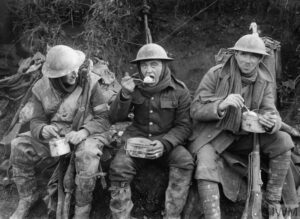
THE BATTLE OF THE SOMME, JULY-NOVEMBER 1916 IWM (Q 1580) British soldiers eating hot rations in the Ancre Valley during the Battle of the Somme, October 1916.
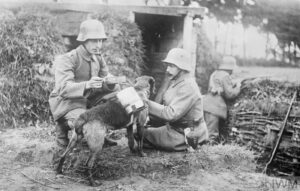
THE GERMAN ARMY ON THE WESTERN FRONT, 1914-1918 IWM (Q 23700) A despatch dog brings food to two German soldiers in an advanced trench, somewhere on the Western Front. The dog is wearing a special harness on its back which can hold mess tins. In the background, a third soldier can be seen pointing his rifle over the top of the trench.
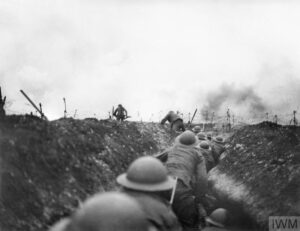
THE GERMAN WITHDRAWAL TO THE HINDENBURG LINE, MARCH-APRIL 1917 IWM (Q 5100) John Warwick Brooke, the official photographer, followed them in the sap, into which a shell fell short killing seven men.
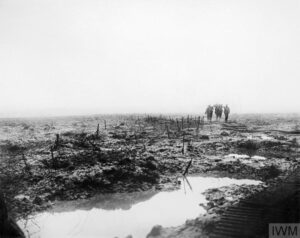
GENERAL SCENES ON THE WESTERN FRONT DURING THE FIRST WORLD WAR: THE THIRD BATTLE OF YPRES, PASSCHENDAELE, 1917 IWM (CO 2252) Canadian stretcher bearers carrying a wounded soldier through the mud of the Ypres Salient, 1917.
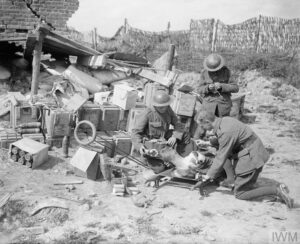
THE BATTLE OF PASSCHENDAELE, JULY-NOVEMBER 1917 IWM (Q 5916) A doctor tends to a shoulder wound at a Regimental Aid Post set up in a captured German ammunition dump at Oosttaverne, near Ypres, August 1917.
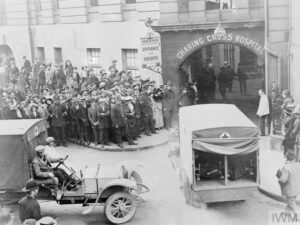
THE MEDICAL SERVICES ON THE HOME FRONT, 1914-1918 IWM (Q 53275) Wounded servicemen arrive in ambulances at Charing Cross Hospital on Agar Street London, September 1914. Onlookers crowd the pavements to view the servicemen.
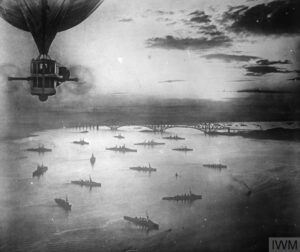
FIRST WORLD WAR IWM (Q 20633) An aerial view of a portion of the Grand Fleet at anchor in the Firth of Forth, taken from the British Airship R. 9.
Apocalyptic explosion: Pixabay by ds-grafikdesign
Below: A raiding party of the 1/8th (Irish) King’s Liverpool Regiment, 55th Division, at Wailly, France. Photograph taken the morning after a night raid during the 17/18th April 1916. Image: IWM (Q 510)
Featured Image: IWM (Q 54564) THE BRITISH HOME FRONT, 1914-1918 (Q 54564) A long queue of children and women awaiting their turn to receive hot food at a public kitchen at 104 Westminster Bridge Road, London. The kitchen was opened by Queen Mary.